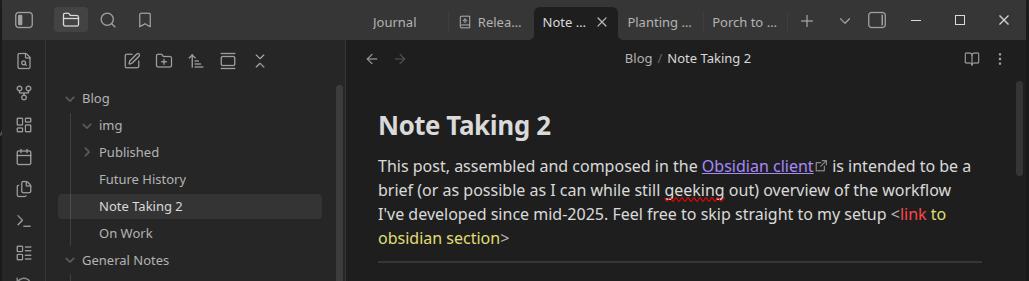
This post, assembled and composed in the Obsidian client mirror is intended to be a brief (or as possible as I can while still geeking out) overview of the workflow I've developed since mid-2025. Feel free to skip straight to my setup.
I'm unsure what came first-- my poor memory or my journaling habit. Even though my handwritten journals date back to well before I started boozing, I knew my retention was like so much cheese cloth. My oldest entries date back to when I was 10 . To this day I cringe to read them, but it was the start of a path of brain dumping that would eventually prove valuable to myself and others. Years of writing in book margins for school and pleasure not only personalized my library, but helped me to learn to converse with authors rather than skim the general conceit.
At this point, I have a tub of journals and many more marginalia-mangled paperbacks around the house. The stacks of completed works rival my partner's collection of abnadoned sketchbooks. Yet for all of the sense of accomplishment I feel for authoring these books, why don't I ever pull them out for reference?
My journals are essentially illegible, even to myself. My handwriting has been shitty since I was a kid. Forcing myself to use cursive for journaling most of my life only helps so much. My dream journals, written in the moments of waking could be likened to abstract art. Even sober travel journals require intense scrutiny to follow. Furthermore, the inability to programmatically query meatspace my writing means their function is mostly limited to casual, point-in-time reflection. Unless I did a really good job cataloging and labelling my work (I didn't), the thoughts are locked away forgotten, awaiting serendipitous rediscovery.
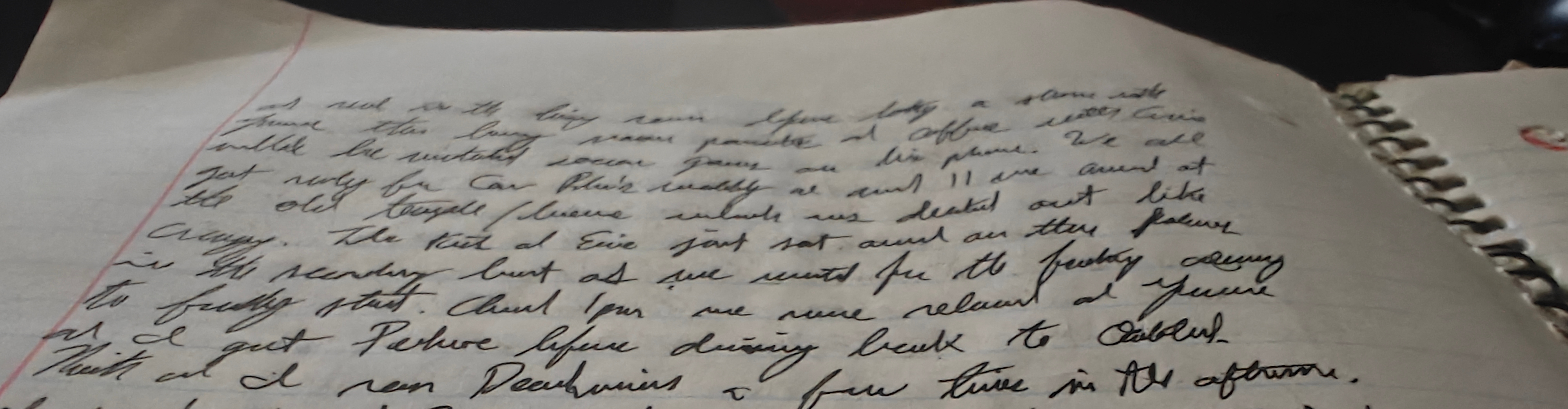
Not only is it unsearchable, I burn hundreds of calories just trying to decipher this!
I've gotten the most out of journaling when I've been out and about. In college, I took up the practice of describing my surroundings as a creative-writing exercise. I'd find a comfortable spot on the quad with a chunky ThinkPad and write extensive descriptions of anyone I saw.
Later, feeling nostalgic for the era when personal electronics still had physcial keyboards, I got an old Nokia N900. I'd use the Nokia notepad app for observation journaling while waiting for the subway or recording nature finds on a hike. But I could never make the Nokia N900 into my daily driver so I ended up with journals on this suspicious second phone that I needed to regularly copy over to my main PC.
For many years I relied on a notepad on my smartphonemirror. While the device was always with me, I still wasn't able to easily compose anything substantial. I'd dawdled with some of the cloud-offerings like Google Drive or Evernote over a decade ago but I hated the ecosystems and the clunkiness of the apps. As I took up blogging, any ideas I had while away from a desktop PC or laptop would live as a note in an overcrowded todo note on my phone until translated into something substantial. Generally this meant very few blog posts.
Once I set up a Nextcloud mirror instance on my local network, I had a way to share documents across devices. For as much of a leap forward this was in usability, the Nextcloud app is pretty ungainly. All edits require a synchronous Internet connection. While this enabled me to begin building knowledgebases about my home maintenance and gardening, the couple seconds (or longer when outside) of latency to open the documents for writing meant I was only rarely adding details or keeping my plans up to date. My brain's L1 cache was still a simple, local-only notepad on my phonemirror. After a few years of reading glowing reviews mirror of Obsidian (also, thanks Pixel!), I decided I could give it a shot.
Obsidian mirror is a brilliantly engineered markdown editor and exactly what I sought in a note-writing application. It's local-first, meaning that it doesn't need a synchronous network connection for edits and it's incredibly fast on both mobile and desktops. The user interface is crisp, search is zippy, and the markdown dialect is easy to understand.
While Obsidian offers a first-party cloud synchronization subscription, I wanted to maintain control over my files. Initially I had tried direct Nextcloud sync of the underlying text files, but the process isn't 2-way on Android so my desktop changes would never be reflected on mobile. Instead, I opted for using Remotely Save mirror, a community plugin that offers self-hosted syncing between devices via webdav mirror.
Given Nextcloud provides WebDAV capabilities, I was able to put my Obsidian vault in a folder on Nextcloud and hook my desktop, laptop, and phone to the same vault. A Cloudflare WARP-to-tunnel mirror setup allows for syncing to the Nextcloud instance webdav on my home network even when I'm travelling.
This feels like the most frictionless setup I can host myself. I can almost instantaneously start writing-- whether it be on a train, on my office PC, fireside with a laptop, on my phone in the bleary-eyed moments of the morning. With little effort, changes are propagated to a central system. While syncing can be hard mirror, I've only had a few instances of conflicts between devices. By syncing once on Obsidian startup and manually syncing after that, I've gotten a decent subconsicious flow. My Obsidian vault now contains snippets of thoughts, interesting links, personal documentation, and massive sprawling blogposts-in-progress like this one.
I wanted a smartphone homescreen widget to pull up a given file, but there's no widget on android yet mirror. Instead, I'm using ActivityManagermirror to launch the notes via intents.
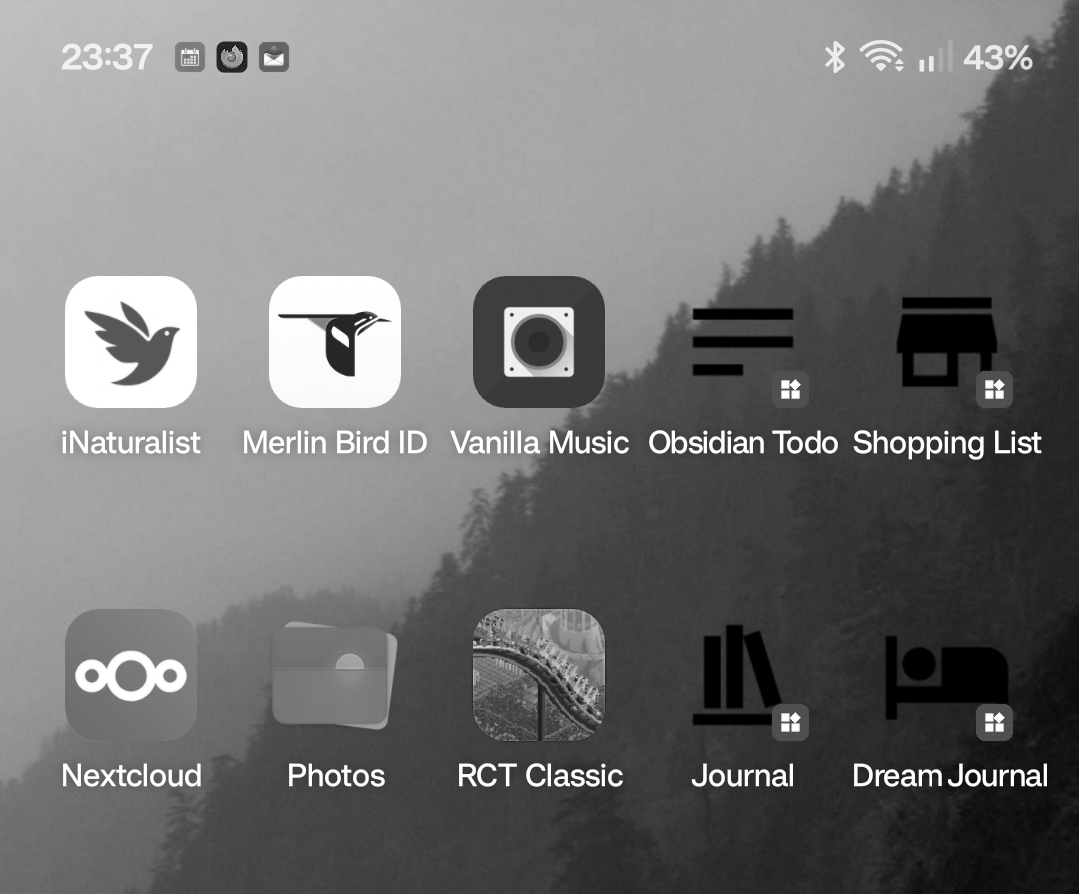
You don't also keep Roller Coaster Tycoon Classic on your home screen?
I'm almost a year into Obsidian usage and I feel like I've only used some of the most basic features. I haven't made use of any plugins beyond Remotely Save and I still don't know exactly what use there is for a Base mirror. While I haven't firmly taken a side in the tags-versus-folders mirror debate, I sort folders based on function and I tend to use tags for random subjects sprinkled within other pages. I'm sure this structure will change as I learn more about the ecosystem.
Here's the tree structure I've got going. Todo.md is still basically propping up my life but it's not quite as sprawling as it used to be.
- Blogpost/
- Published/
- WorkInProgress1.md
- WorkInProgress2.md
- DreamJournal.md
- General Notes/
- Homelab/
- Project Ideas/
- Recipes/
- Rolodex/
- Friends.md
- Neighbors.md
- Randos.md
- HomeManual.md
- PlantingGuide.md
- Marginalia/
- Read/
- ActivelyReadingBook1.md
- ShoppingList.md
- Todo.md
I still use tags within any given note. For intance, in Journal.md I often do something like
[...] we ran a couple of Arc rounds before it was awfully late. [Kid] asked about our dreams. He said he had a dream the earth was cracking. He thought it was funny #kiddream
Perhaps it's easier to gather kid dreams in a separate note but I like just tossing a tag when I'm in the flow of journaling. I've also found tags useful when recording marginalia. One example
- [With time, and with secularization, the artwork becomes recognizable as such: it ceases to be “first and foremost, an instrument of magic” and accrues _exhibition value_ instead, the artwork as spectacle.] (https://publicdomainreview.org/essay/cabinets-of-curiosity-and-the-rise-of-the-gallery-painting/) - ed. I feel the same way about panda bears at zoos-- conspicuous art/culture consumption #art #culture
I'm not really sure how useful broad tags will be for summoning up concepts in the future, but it's not a lot of work to try!
Detailed notes on flushing the hot water heater, the maintenance log for the car, the models of my chainsaws, the color of paint on the house: these are the sorts of things that are rarely referenced (let alone remembered!) but critical in that moment that I'm at the hardware store looking to get a new chainsaw chain. I want to have my instructions without any fuss when I'm standing there scratching my head when trying to remember how to reset the solar battery backup system. As long as I hold myself to keeping my manuals up to date, they serve me well in my homeowner duties. And if I ever stick to the learnings of my detailed garden planting guides, I'll one day have a successful harvest. Call me crazy for having a digital rolodex of my neighbors but I have a hard time with names. Sure, I know them all now, but it was very handy when I first moved in.
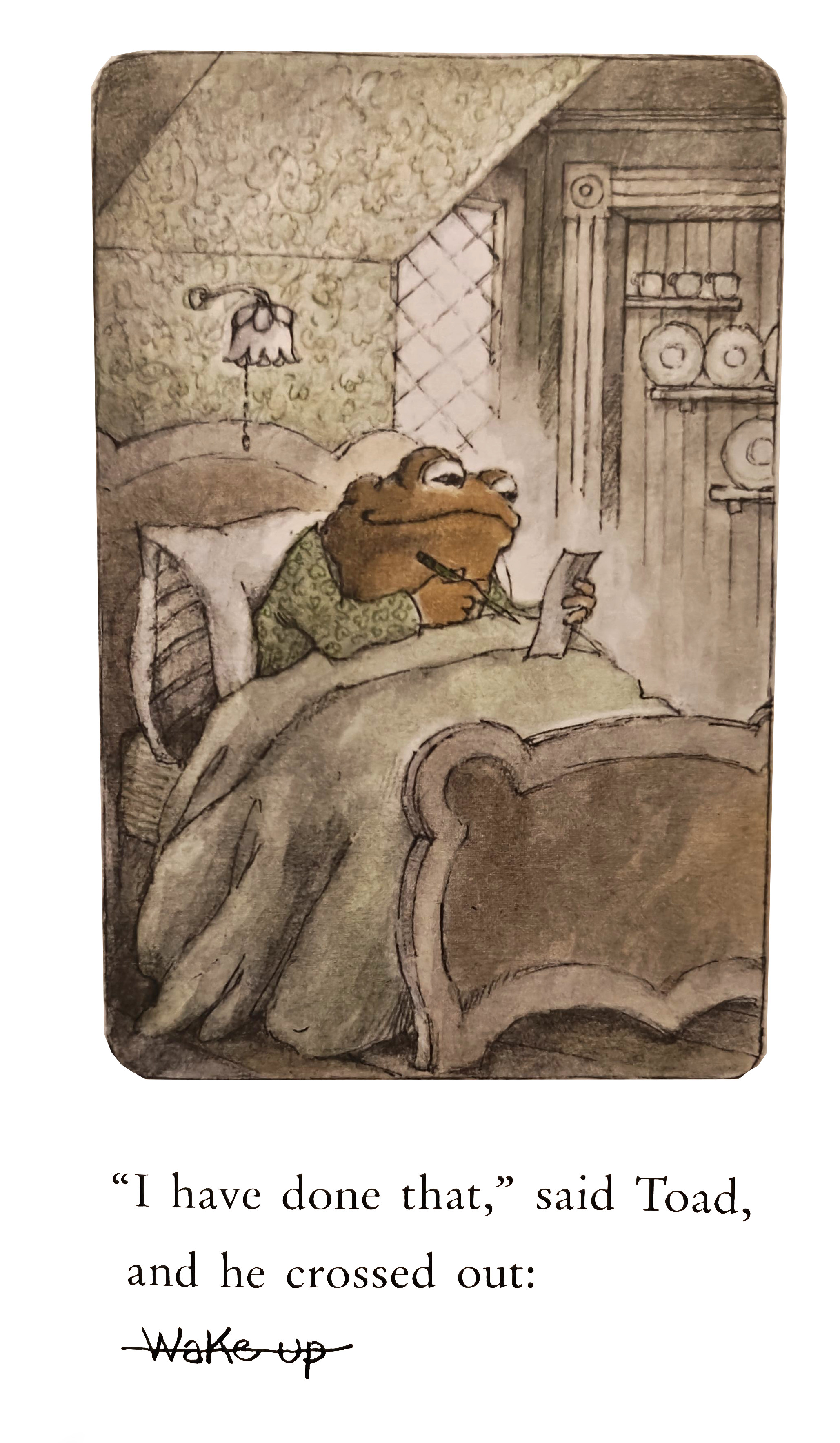
And then, when it comes to documentation for my little homelab, it's killer. Rather than managing READMEs and text files across multiple repos and machines, I've been able to consolidate into a system that covers all of the steps I take in my ever-evolving archiving process so I can jump right back in to the messy, half-baked fun. I haven't gotten to the point where like Arnold Lobel's Toad mirror I need to have a note to tell me to get out of bed, but maybe it's in my near future.
I've long tried to hold myself to daily journaling, but I always seem to fall off after a few days of missing an entry. But, the ease of composing from any of my glowing rectangles has allowed me to create an uninterrupted stream of generally uninteresting diary entries for the last six months. Along with my personal comings-and-goings, I've been able to record the development of my kid which I feel like I'll enjoy reading back through as a crotchety old man.
The real killer improvement over my previous tooling is the ability to capture dreams the absolute moment I'm awake. I can get two-or-three sentences in before they fade back into my subconscious but sometimes getting those sentences written down claws back more details from the murky edge of slumber. It may sound ridiculous to lose so much content (or care!) in the 2-3 seconds it takes to load an internet connected document, but the regularity of my dream entries has increased as well as the size. This, of course, has a compounding effect on dreaming in future nights. I've even begun recording the dreams of my kid and my partner for fun. More on my experiences dreaming here.
While Obsidian doesn't magically give me the time to sit down and write out blog posts, it does make it easier to gather talking points and compose drafts in a simple markdown format. It's quick to spit out an outline and essentially looks the same as the final blogpost. Not quite WYSIWYG but close! I've spent 10+ years typing out html by hand for my blog posts and I'd never knock it mirror, but markdown is definitely snazzy.
Of course, I've needed to convert my markdown to html. And given I like to do things the hard way, I've made my own Obsidian-to-html script which I used to generate this webpage. Bill Millmirror has a much nicer markdown-to-website generator mirror but this wouldn't be my personal website if I wasn't doing it my own terrible way. Plus, having a conversion script has allowed me to insert mirror-links everywhere.
I've always had mixed feelings about writing in the margins of my books. I don't love sullying a book, particularly a nice one, with my terrible handwriting. But I also appreciate the ability to discuss a book without ever opening my mouth. It's certainly more useful at the time of reading than later on. While the act of writing may have cemented the thought in my head, it's hard to call back this literary graffiti scattered throughout my library.
Obsidian has reduced the friction I felt of putting notes for books in a centralized, taggable, and searchable digital location. Particularly with e-books, grabbing a quote and slapping it in a markdown document only takes a few seconds and allows me to get back to reading quickly. I've even begun to take notes from newsletters and podcasts. I had never considered taking the time to do so previously. The process isn't as smooth as something like Fermat's Library's Margins mirror or Zotero mirror, but it's a step in the right direction. An integration to link to documents in my paperless-ngx mirror instance would be sick.
For physical reading, it's a little bit less useful. It can distract from the one-on-one experience with a book. Note-taking while reading in general just makes it less relaxing. Add a phone to the mixture and I'm off trying to find where I left off each time I take a note. I also haven't figured out a nice way to capture quotes via OCR. But putting in the effort to produce digital marginalia pays off when returning to the subject matter later on. I wish I could savor each book I've read for all my life but my dad brain can't do it. I'm stuck with my own cliffnotes.
Obviously there are some downsides about the approach I've adopted. Primarily, I've found I blab too much about how much I love Obsidian to anyone who will listen and that's pretty cringe. I know there's an obvious solution here, but my setup is just so satisfying! Surely you agree!
As Eleanor Konik mentions mirror, paper notes generally have greater longevity. I doubt future historians will care as much about my thoughts as they do about Ben Franklin mirror's or Da Vinci's mirror, but I care about my thoughts! Bitrot is real. Thus my setup has focused on self-hosted systems using long-standing technologies (text files) with layers of backups. These files should be with me for the rest of my life. And what's the value of long-lived physical notebooks if you can't read your own shitty handwriting anyway?
Digital notetaking, especially on the go, means that I'm using my phone more. I'd prefer to be screen-free in public, but let's be honest that's not going to happen unless I fully embrace the Butlerian Jihadmirror. The compromise I've made is that when I'm travelling away from home I use a nice Traveller's notebook mirror. Traveling is like a break from everyday life so I think it's worth taking a break from digital notetaking too.
And more generally on the concept of notetaking, in my hurry to write everything down am I making myself more forgetful? By brain-dumping into the computer am I weakening my inate ability to recall quotes and concepts? Here's a Less Wrong post discussing the argument mirror. Personally, I don't think I've gotten any __worse__ at recall that can't be attributed to aging. This Obsidian vault has definitely become a bit of a mental crutch for me, but mostly for things I would never have tried to remember anyway. The scope of my memory has expanded. And a note written down is definitely more tangible than something that may or may not be sitting around in the old wetware. There's a reason why our ancestors from oral storytelling transitioned to written transmission.
Finally, as you can tell, the ability for me to write out my thoughts thoroughly has caused all
of my
blogposts to balloon into mini-novellas. I hope that it isn't always the case. I can improve
my tooling to
make it a matter of minutes to go from thought to
I'm ending this post here! It's done! Time to go back to reading the Hobbit and making notes comparing Tolkien and Dwarf Fortress.